ABSTRACT
This study investigates the effect of supramolecular structure on the optical properties of polypropylene (PP) composites filled with nanoquartz silicon dioxide (SiO2).
It was found that the addition of SiO2 nanoparticles leads to a decrease in the band gap due to the formation of new trap states or structural defects. The change
in the band gap is attributed to electronic interactions at the polymer–filler interface and structural rearrangement of the polymer near the surface of the nanoparticles.
Cooling conditions significantly influence the supramolecular structure of the PP+SiO2 composite, leading to variations in its optical behavior. Slow cooling promotes
crystallization and causes a redshift in the absorption spectrum, while rapid cooling increases amorphousness and results in a blueshift. By tuning the band gap and the
supramolecular structure, it is possible to design materials with desired optical characteristics for various applications. The reduction in band gap with increasing
nanoparticle content enhances the electrical conductivity and photoactivity of the material, making it suitable for use in sensors, photocatalysts, and electronic devices.
Keywords: supramolecular structure, band gap, rapid cooling, slow cooling.
DOI:10.70784/azip.1.2025245
Received: 20.05.2025
Internet publishing: 18.06.2025 AJP Fizika E 2025 02 en p.45-48
AUTHORS & AFFILIATIONS
Institute of Physics, Ministry of Science and Education, 131 H. Cavid Avenue, Baku, AZ 1073, Azerbaijan
E-mail: hicran90@rambler.ru
Graphics and Images
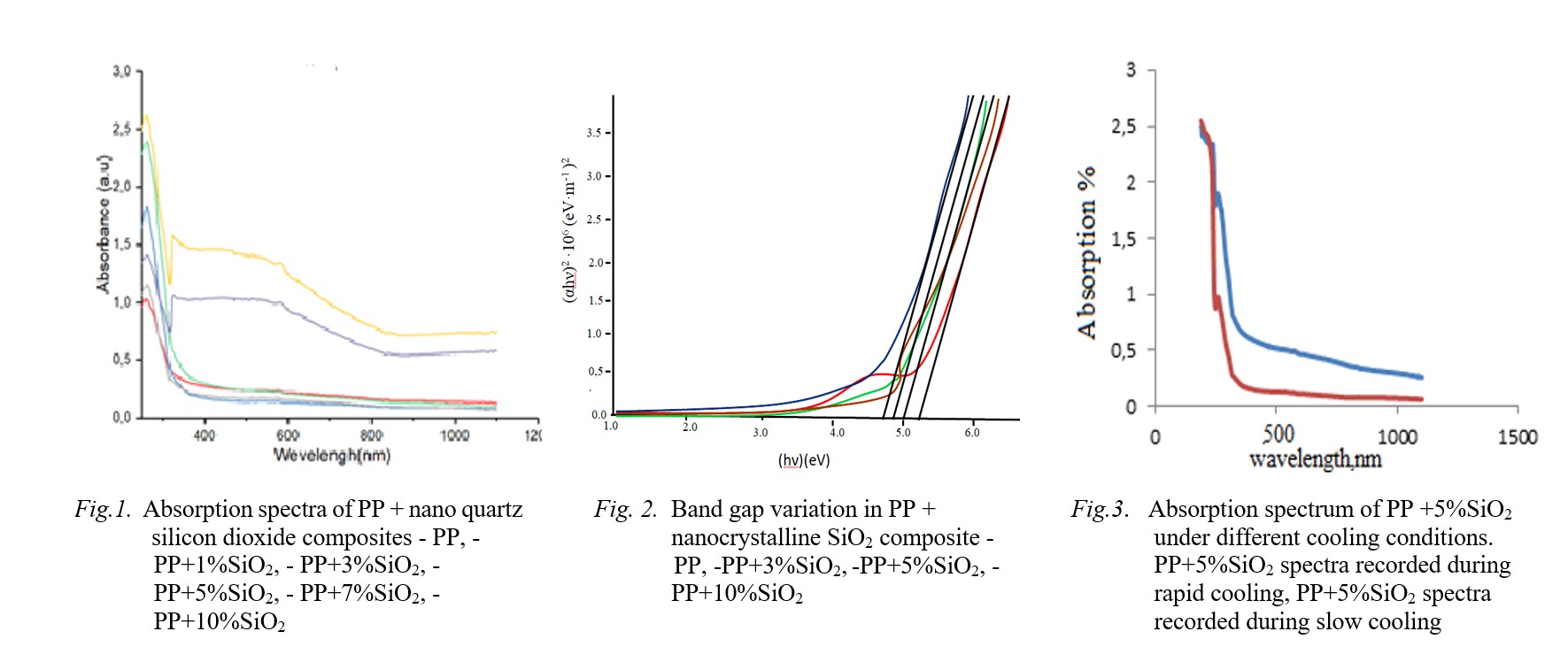
Fig.1-2-3
|
[1] Bogna Sztorch, Eliza Romańczuk-Ruszuk, Ewa Gabriel, Daria Pakuła, Rafał Kozera, Robert E. Przekop. Metal and metal oxide particles as modifiers for effective layer melting and Z-axis strength in 3D printing Polymer Volume 294, 16 February 2024, 126684 https://doi.org/10.1016/j.polymer.2024.126684
[2] M. Jinish Antony, C. Albin Jolly, K. Rohini Das, T.S. Swathy. Normal and reverse AOT micelles assisted interfacial polymerization for polyaniline nanostructures Colloids Surf, A, 578 (2019), p. 123627
[3] B. Prasad, et al. Development of conductive nanocomposite for sensing application Int J Eng Technol, 7 (2018), p. 1025
[4] H.S. Ibrahimova, R.M. Rzayev, E.M. Mustafayeva. Thermophyical Properties PP/ZrO2 Nanocomposites Before and After Electrothermal Polarization Journal of Inorganic and Organometallic Polymers and Materials https://doi.org/10.1007/s10904-024-03062-y V 34 pp4655–4660, (2024)
[5] J. Tauc. Optical properties of amorphous semiconductors. In Amorphous and Liquid Semiconductors; Tauc, J., Ed.; Plenum Publishing Co.: London, UK, 1974; pp. 159–200
[6] S. Gardelis, P. Manousiadis, & A.G. Nassiopoulou. Lateral electrical transport, optical properties and photocurrent measurements in two-dimensional arrays of silicon nanocrystals embedded in SiO2. Nanoscale Res Lett 6, 227 (2011). https://doi.org/10.1186/1556-276X-6-227
[7] Wenjing Yuan, Feng Wang, Zheming Chen, Chong Gao, Peng Liu, Yanfen Ding, Shimin Zhang, Mingshu Yang. Efficient grafting of polypropylene onto silica nanoparticles and the properties of PP/PP-g-SiO2 nanocomposites Polymer 151, 2 2018, Pages 242-249
[8] Wei-Long Ju, Shao-Fan Li, Yun-Lan Su, Du-Jin Wang. Controllable Synthesis of a Well-defined Polypropylene grafted Silica Nanoparticles and Its Effect on Crystallization Behavior of Polypropylene. Chin J Polym Sci 40, 1411–1421 (2022). https://doi.org/10.1007/s10118-022-2756-7
|