ABSTRACT
The article studies the effect of ultraviolet illumination on the optical emission spectrum of a Ga6Sb18S76 chalcogenide glassy thin film.
It was found that the increase in the optical bandgap (Eg) at the initial stage of the exposure time (t=0-20 min) is due to the breaking of low-energy Sb-Sb (1.31 eV),
Ga-Ga (1.48 eV) bonds under the influence of photo-induction, as well as the formation of new high-energy bonds (Ga-S, Sb-S, Ga-O, Sb-O) due to chemical activity. It is
shown that the decrease in Eg at the exposure time of t=20-40 min may be due to the breaking of high energy Ga-S (~2.51 eV) and Sb-S (~2.23 ÷3.59 eV) bonds under the
influence of photo-induction. A slight increase in Eg at an exposure time of t=40–90 min is due to the formation of a thin layer of stronger oxide bonds (Ga-O, Sb-O) on the
surface as a result of the rupture of highly concentrated heteropolar bonds (Ga-S, Sb-S) and as a result, photo-induced volume expansion occurs.
Keywords: amorphous, glass, phototransparency, photodarkening
DOI:10.70784/azip.2.2025262
Received: 02.06.2025
Internet publishing: 20.06.2025 AJP Fizika A 2025 02 az p.62-65
AUTHORS & AFFILIATIONS
Institute of Physics named after H.M.Abdullayev of the Ministry of Science and Education Republic of Azerbaijan, 131 H.Javid ave. Baku, AZ-1073, Azerbaijan
E-mail: Rahim-14@mail.ru
Graphics and Images
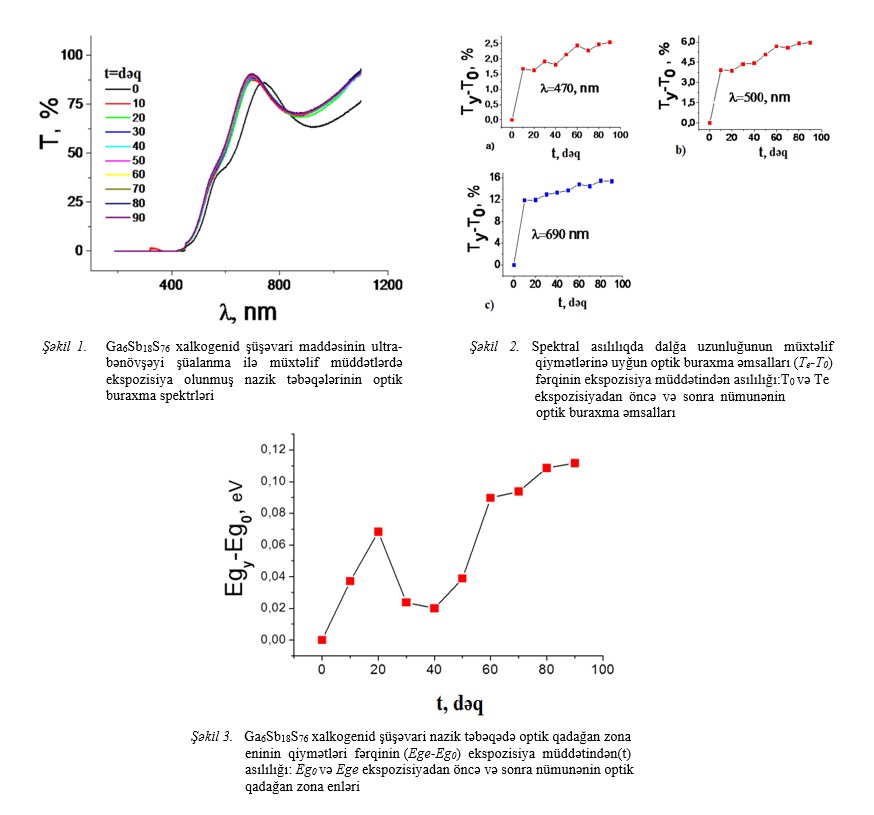
Fig.1-2-3
|
[1] L Liu, X Zheng, X Xiao, Y Xu, X Cui, J Cui, C Guo, J Yang, H Guo. Vol. 9, № 9 / 1 September 2019 / Optical Materials Express 3582-3593.
[2] J. L. Adam and X. Zhang, Chalcogenide Glasses: Preparation, Properties and Applications (Woodhead Publishing, 2014).
[3] S. D. Jackson. “Towards high-power mid-infrared emission from a fibre laser,” Nat. Photonics 6(7), 423–431, 2012.
[4] B.J. Eggleton, T.D. Vo, R.Pant, M. Pelusi, D.Yong Choi, S. Madden, and B. Luther-Davies. “Photonic chip based ultrafast optical processing based on high nonlinearity dispersion engineered chalcogenide waveguides,” Laser Photonics Rev. 6(1), 97–114, 2012.
[5] M.-L. Anne, J. Keirsse, V. Nazabal, K. Hyodo, S. Inoue, C. Boussard-Pledel, H. Lhermite, J. Charrier, K. Yanakata and O. Loreal, et al. “Chalcogenide glass optical waveguides for infrared biosensing,” Sensors 9(9), 7398–7411, 2009.
[6] J. Cui, X. Xiao, Y. Xu, X. Cui, M. Chen, J. Guo, M. Lu, B. Peng and H. Guo. “Mid-infrared emissions of Dy3+ doped Ga-As-S chalcogenide glasses and fibers and their potential for a 4.2 μm fiber laser,” Opt. Mater. Express 8 (8), 2089–2102, 2018.
[7] M. Asobe, T. Ohara, I. Yokohama, and T. Kaino. “Fabrication of Bragg grating in chalcogenide glass fibre using the transverse holographic method,” Electron. Lett.32(17), 1611–1613 1996.
[8] M. Bernier, M. El-Amraoui, J. Couillard, Y. Messaddeq and R. Vallée. “Writing of bragg gratings through the polymer jacket of low-loss as 2 s 3 fibers using femtosecond pulses at 800 nm,” Opt. Lett. 37(18), 3900–3902, 2012.
[9] A.A. Othman. Influence of ultraviolet irradiation on the optical properties of amorphous Sb10Se90 thin films, Thin Solid Films 515, 2006, 1634–1639.
[10] D. Usanov, A. Nezhdanov, M. Kudryashov, I. Krivenkov, A. Markelov, V. Trushin, L. Mochalov, D. Gogova, A. Mashin. Some insights into the mechanism of photoluminescence of As-S-based films synthesized by PECVD. Journal of Non-Crystalline Solids, 2019, v 513, p.120–124.
[11] Y Zhang, Q Jiao, B Ma, X Zhang, X Liu, S Dai. Effective ionic transport in AgI based Ge(Ga)–Sb–S chalcogenide glasses Journal of the American Ceramic Society, 2019, v.102, p.7065-7070
[12] A.A. Othman, H.H. Amer, M.A. Osman and A.Dahshan. Radiation Effects & Defects in Solids. 2004, Vol. 159, pp. 659–666.
[13] L.Tichy, H. Ticha, P. Nagels and R. Callarets. 1998, Mat. Letts.,36, 294.
[14] J.Z. Liu and P.C. Taylor. 1990, Phys. Rev. B, 41, 3163.
[15] K. Tanaka. Amorphous Chalcogenide Semiconductors and Related Materials, K. Tanaka, K. Shimakawa, Springer Nature Switzerland AG, 2021, p. 310.
|