ABSTRACT
The dielectric permeability ε′ and dielectric loss factor ε″ of solid chlorobenzene were studied using dielectric spectroscopy in the frequency range 5.5·104-5.0·106 Hz and
in the temperature range –80÷–40°C. Two regions of relaxation dispersion were found in the solid phase, differing in characteristic relaxation times and activation energy
parameters. Based on the analysis of the temperature and frequency dependencies of ε′ and ε″, possible mechanisms of molecular mobility associated with the rotational
motions of molecules and the structural heterogeneity of the crystal lattice in the region up to the melting point are discussed.
Keywords: dielectric spectroscopy, dielectric relaxation, complex dielectric permittivity, solid state, chlorobenzene.
DOI:10.70784/azip.1.2026107
Received: 23.12.2025
Internet publishing: 21.01.2026 AJP Fizika E 2026 1 en p.07-10
AUTHORS & AFFILIATIONS
1. Ministry of Science and Education Republic of Azerbaijan, Institute of Physics,
2. Baku Business University, Baku, Azerbaijan
E-mail: 1. Corresponding Author: samirazizov2012@gmail.com
2. ibrahimqizisvetlana@gmail.com
1. ORCID: https://orcid.org/0000-0001-6252-1512
Graphics and Images
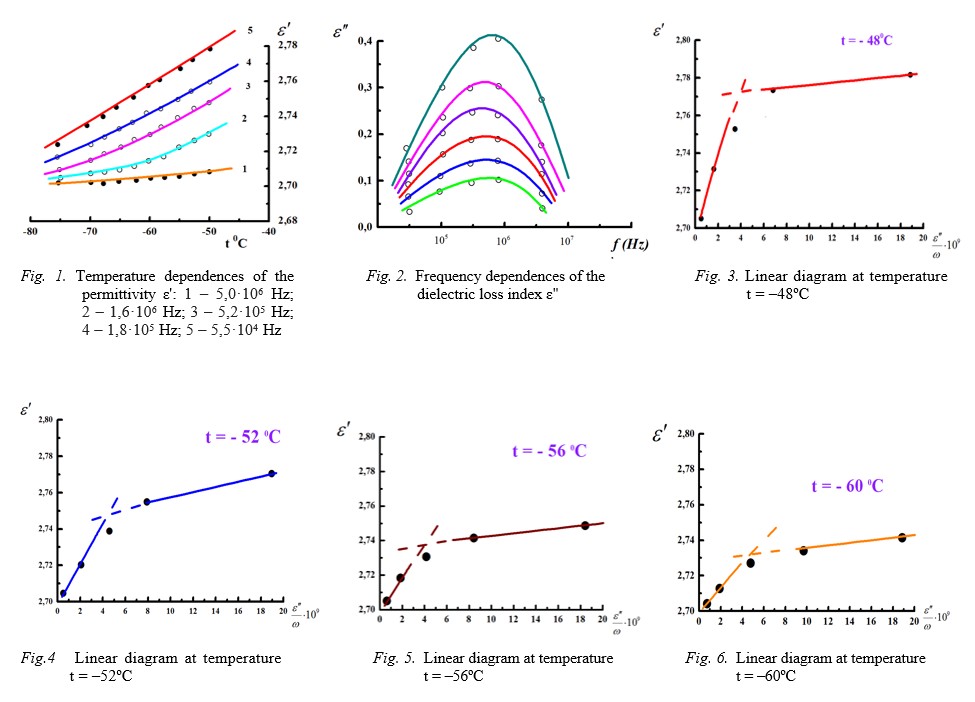
Fig.1-2-3-4-5-6
|
[1] S.K. Kim, L. Onsager. The integral representation of the relaxation effects in mixed strong electrolytes in the limiting law region, J. Phys. Chem. 81 (1977) 1211-1213, https://doi.org/10.1021/j100527a019
[2] Дебай П. Полярные молекулы. — М.: ИЛ, 1961. — 428 с.
[3] R.H. Cole. Dielectric polarization and relaxation, Mol. Liq., NATO ASI Ser. C 135 (1984) 59-110, https://doi.org/10.1007/978-94-009-6463-1_3.
[4] H. Sato, T. Koshii, H. Takahashi, K. Higasi. Dielectric relaxation and molecular structure. XIV. The dielectric behavior of six isomeric pentyl alcohols, Bull. Chem. Soc. Jpn. 48 (1975) 1317–1318, https://doi.org/10.1246/bcsj.48.1317.
[5] E.L. Smith, A.P. Abbott, K.S. Ryder. Deep eutectic solvents (DESs) and their applications, Chem. Rev. (2014) 11060-11082, https://doi.org/10.1021/cr300162p.
[6] C. Zhang, M. Sprik, Computing the dielectric constant of liquid water at constant dielectric displacement, Phys. Rev. B 93 (2016) 144201, https://doi.org/10.1103/PhysRevB.93.144201.
[7] I.N. Daniels, Zh. Wang, B.B. Laird. Dielectric properties of organic solvents in an electric field, J. Phys. Chem. C 121 (2016) 10896-10920, https://doi.org/10.1021/acs.jpcc.6b10896.
[8] M. Nagasaka, H. Yuzawa, N. Kosugi. Microheterogeneity in aqueous acetonitrile solution probed by soft x-ray absorption spectroscopy, J. Phys. Chem. B 124 (2020) 1259-1265, https://doi.org/10.1021/acs.jpcb.0c00551.
[9] S.R. Cohen, M. Plazanet, St. Rols, D.J. Voneshen, J.T. Fourkas et al., Structure and dynamics of acetonitrile: molecular simulation and neutron scattering, J. Mol. Liq. 348 (2022) 118423, https://doi.org/10.1016/j.molliq.2021.118423.
[10] N.A. Chaudhary, C.R. Vaja, K.J. Agheda, K.N. Shah, V.A. Rana, A.N. Prajapati. Insights into molecular interactions: dielectric relaxation and DFT-based studies on n-hexanol/N,N-dimethylformamide binary mixtures, J. Mol. Liq. 425 (2024) 126675, https://doi.org/10.1016/j.molliq.2024.126675.
[11] G. Chahi, D. Bradai, I. Belabbas. Hydrogen bonds and elastic anisotropy of nitrile molecular crystals: an investigation from first-principles, Mol. Simul. 50 (2024) 696-709, https://doi.org/10.1080/08927022.2024.2342971.
[12] A.A. Basha, F.L.A. Khan, B.H.K. Hussain. Dielectric relaxation and thermodynamical parameters of hydrogen bonded complexes for heptanamide and pentanamide with halogenated phenols in benzene, J. Mol. Liq. 363 (2022) 119853, https://doi.org/10.1016/j.molliq.2022.119853.
[13] S.T. Azizov. Dielectric relaxation in solutions chlorobenzene-benzene and chlorobenzene-hexane, Mod. Phys. Lett. B 38 (2024) 2450167, https://doi.org/10.1142/S0217984924501677.
[14] S.T. Azizov. Investigation of the temperature dependence of the dielectric relaxation of chlorobenzene, bromobenzene and iodobenzene, Bull. Karaganda Univ. Phys. 29 (2024) 36-42, https://doi.org/10.31489/2024ph2/36-42.
[15] E. Salaev, S. Azizov, E. Gasimov, J. Qajar. Resonant reflectionless absorption of electromagnetic waves in solutions, Turk. J. Phys. 22 (1998) 389-394. https://journals.tubitak.gov.tr/physics/vol22/iss5/4/
[16] C.J.F. Böttcher, P. Bordwijk. Theory of electric polarization, Amsterdam 2 (1978), https://doi.org/10.1002/bbpc.19800841128.
[17] S.T. Azizov. Temperature dependence of dielectric relaxation of absorption spectra in the chlorobenzene–iodobenzene system, East Eur. J. Phys. 1 (2024) 453-459, https://doi.org/10.26565/2312-4334-2024-1-50.
[18] S.T. Azizov, O.A. Aliyev, Kh.Kh. Hashimov. Dielectric relaxation and molecular interactions in acetic acid, East Eur. J. Phys. 3 (2025) 483-489, https://doi.org/10.26565/2312-4334-2025-3-53
|