ABSTRACT
The article explains the thermal expansion of solids using a harmonic oscillator model. It assumes atoms oscillate around equilibrium points in a crystal lattice. If
oscillations were purely harmonic, thermal expansion would not occur; expansion arises from anharmonicity. Anharmonicity introduces an additional term in the potential
energy expression, leading to a non-zero thermal expansion coefficient. The theoretical results agree with experimental data, such as the temperature dependence of copper’s
thermal expansion coefficient. At high temperatures, the thermal expansion coefficient becomes nearly constant. At low temperatures, it follows a T³ dependence and approaches
zero as temperature approaches absolute zero. Factors affecting thermal expansion differ between metals and semiconductors; in metals, the electron gas plays a significant
role. In semiconductors, impurities, defects, and changes in the band gap also influence the expansion coefficient. The Debye temperature can be estimated from experimental
values of the thermal expansion coefficient.
Keywords: Thermal expansion, solids, harmonic oscillator model, anharmonicity, potential energy
DOI:10.70784/azip.1.2026111
Received: 24.12.2025
Internet publishing: 21.01.2026 AJP Fizika E 2026 1 en p.11-15
AUTHORS & AFFILIATIONS
Sumgait State University, Sumgait, Azerbaijan
E-mail: hasimovaaynur@gmail.com
Graphics and Images
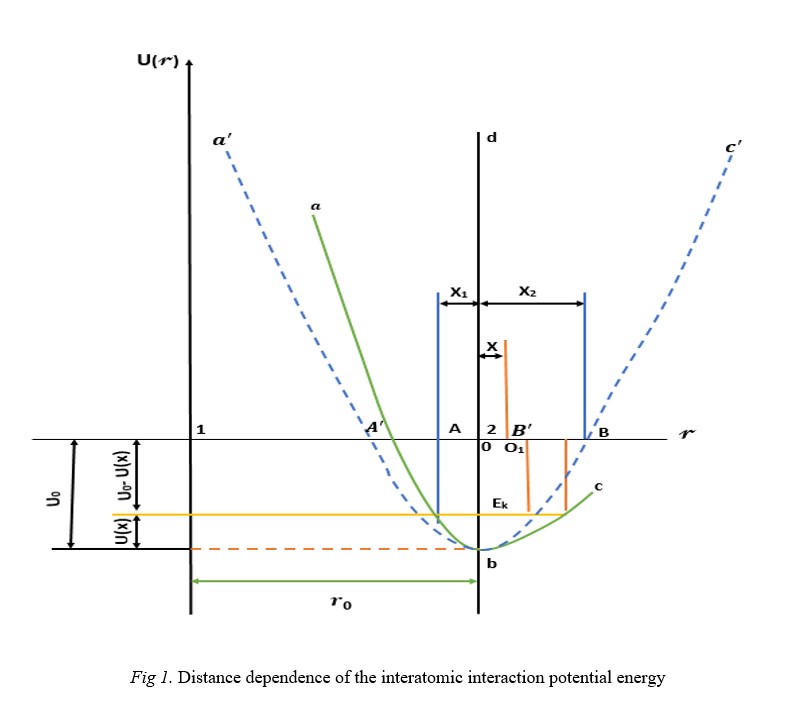
Fig.1
|
[1] C. Kittel and P. McEuen. Introduction to Solid State Physics 8th ed. (Wiley New York 1996) Google Scholar
[2] D.C. Wallace, Thermodynamics of Crystals (Wiley, 1972). Google Scholar, Crossref
[3] J.P. Dismukes et al., J. Phys. Chem. 68, 3021 (1964).
[4] N.V. Hung J.J. Rehr. Anharmonic correlated Einstein-model Debye–Waller factors. Phys Rev B. 997; https://doi.org/10.1103/PhysRevB.56.43.
[5] J.C. Slater. Note on Grüneisen’s constant for the incompressible metals. Phys Rev. 1940; https://doi.org/10.1103/PhysRev.57.744
[6] M.M. Kurbanov, D.D. Bayramov, N.S. Sardarova. Thermal expansion of TlInX2 (x-s, Se,Te). Inorganic Materials, Moscow: -2000, № 2, -p. 183–184.
[7] G.K. White. Thermal Expansion at low temperatures. Nature, -1960, v. 187, № 4721, -p.927–929.
|