ABSTRACT
This paper presents the results of an experimental study of the complex dielectric permittivity (ε' and ε") of bromobenzene-benzene and bromobenzene-hexane binary systems
in the microwave range (λ = 12.8 mm) at temperatures from 293 K to 193 K. The aim of the study is to establish the relationship between molecular dynamics, thermodynamic
parameters, and the nature of the solvent in the process of dielectric relaxation. The temperature dependence of the dielectric relaxation time (τ) for each system was
determined. It was found that an increase in the size of the halogen substituent leads to an increase in τ. Based on the theory of absolute reaction rates, the thermodynamic
parameters of relaxation process activation were calculated: free energy (ΔF), enthalpy (ΔH), and entropy (ΔS). The influence of intermolecular interactions and solvent
structure on energy barriers and system order in the process of dipole reorientation is shown.
Keywords: dielectric relaxation, bromobenzene, benzene, hexane, thermodynamics, microwave range, relaxation time, intermolecular interactions.
DOI:10.70784/azip.1.2026116
Received: 08.01.2026
Internet publishing: 22.01.2026 AJP Fizika E 2026 1 en p.15-20
AUTHORS & AFFILIATIONS
1. Ministry of Science and Education Republic of Azerbaijan, Institute of Physics,
2. Baku Business University, Baku, Azerbaijan
E-mail: 1. Corresponding Author: samirazizov2012@gmail.com
2. ibrahimqizisvetlana@gmail.com
1. ORCID: https://orcid.org/0000-0001-6252-1512
Graphics and Images
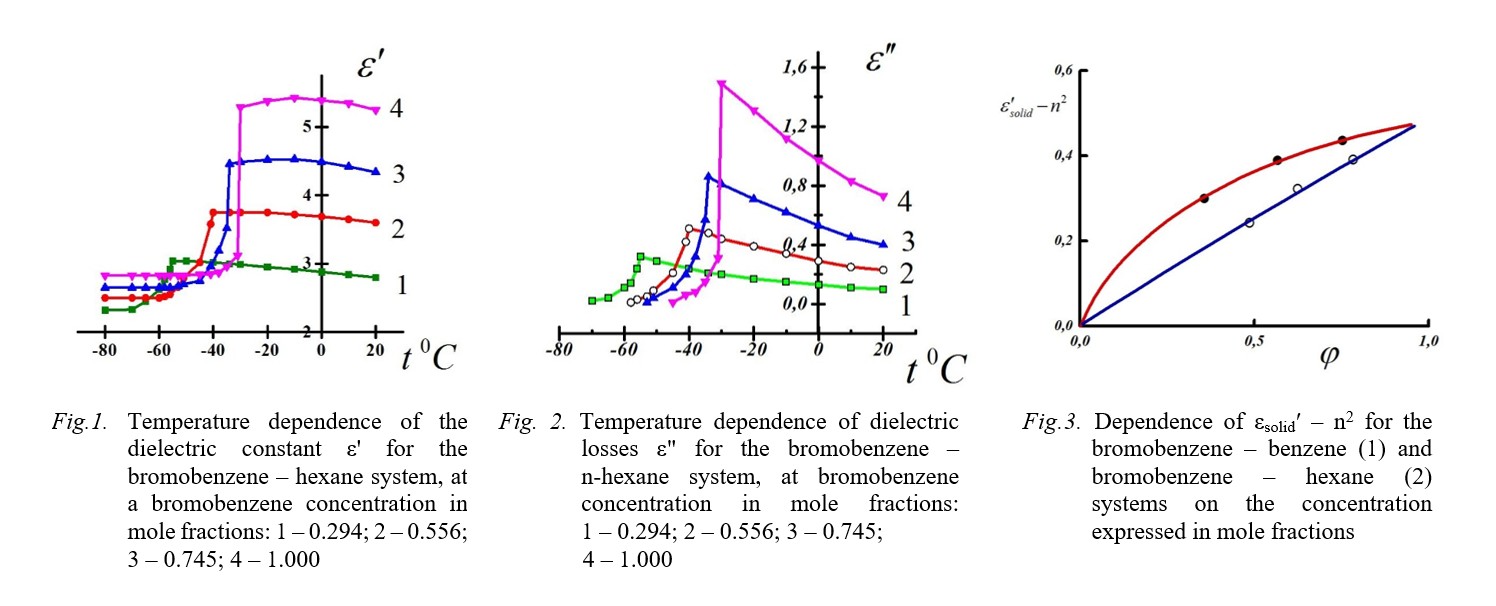
Fig.1-2-3
|
[1] C.J.F. Böttcher, P. Bordwijk, Theory of electric polarization, Amsterdam 2 (1978), https://doi.org/10.1002/bbpc.19800841128.
[2] H. Yu Yao, Y. Ch. Wang, T.H. Chang. Investigation of dielectric spectrums, relaxation processes, and intermolecular interactions of primary alcohols, carboxylic acids, and their binary mixtures, Journal of Molecular Liquids, v 353, (2022) 118755, https://doi.org/10.1016/j.molliq.2022.118755
[3] R.H. Cole. Dielectric polarization and relaxation, Mol. Liq., NATO ASI Ser. C 135 (1984) 59-110, https://doi.org/10.1007/978-94-009-6463-1_3.
[4] H. Sato, T. Koshii, H. Takahashi, K. Higasi. Dielectric relaxation and molecular structure. XIV. The dielectric behavior of six isomeric pentyl alcohols, Bull. Chem. Soc. Jpn. 48 (1975) 1317–1318, https://doi.org/10.1246/bcsj.48.1317.
[5] P. Debye. Polar Molecules. Chemical Catalog Company. (1929). https://doi.org/10.1002/jctb.5000484320
[6] H. Eyring. The Activated Complex in Chemical Reactions. The Journal of Chemical Physics, (1935).3(2), 107-115.
[7] S.K. Kim, L. Onsager. The integral representation of the relaxation effects in mixed strong electrolytes in the limiting law region, J. Phys. Chem. 81 (1977) 1211-1213, https://doi.org/10.1021/j100527a019
[8] J.Ph. Poley. Microwave dispersion of some polar liquids, Appl. Sci. Res. B 4 (1955) 337-387, https://doi.org/10.1007/BF02920014.
[9] C. Zhang, M. Sprik. Computing the dielectric constant of liquid water at constant dielectric displacement, Phys. Rev. B 93 (2016) 144201, https://doi.org/10.1103/PhysRevB.93.144201.
[10] M. Nagasaka, H. Yuzawa, N. Kosugi. Microheterogeneity in aqueous acetonitrile solution probed by soft x-ray absorption spectroscopy, J. Phys. Chem. B 124 (2020) 1259-1265, https://doi.org/10.1021/acs.jpcb.0c00551.
[11] S.R. Cohen, M. Plazanet, St. Rols, D.J. Voneshen, J.T. Fourkas et al., Structure and dynamics of acetonitrile: molecular simulation and neutron scattering, J. Mol. Liq. 348 (2022) 118423, https://doi.org/10.1016/j.molliq.2021.118423.
[12] S.D. Deshmukh, K.L. Pattebahadur, A.G. Mohod, P.W. Khirade. Dielectric and spectroscopic study of binary mixture of acrylonitrile with chlorobenzene, AIP Conf. Proc. 1953 (2018) 050039, https://doi.org/10.1063/1.5032694.
[13] V.P. Pawar, S.C. Mehrotra. Dielectric relaxation study of liquids having chloro group with associated liquids. I. Chlorobenzene with methanol, ethanol, and 1-propanol, J. Solut. Chem. 31 (2002) 559-576, https://doi.org/10.1023/A:1020293629513.
[14] G. Chahi, D. Bradai, I. Belabbas. Hydrogen bonds and elastic anisotropy of nitrile molecular crystals: an investigation from first-principles, Mol. Simul. 50 (2024) 696-709, https://doi.org/10.1080/08927022.2024.2342971.
[15] A.A. Basha, F.L.A. Khan, B.H.K. Hussain. Dielectric relaxation and thermodynamical parameters of hydrogen bonded complexes for heptanamide and pentanamide with halogenated phenols in benzene, J. Mol. Liq. 363 (2022) 119853, https://doi.org/10.1016/j.molliq.2022.119853.
[16] S.T. Azizov. Dielectric relaxation in solutions chlorobenzene-benzene and chlorobenzene-hexane, Mod. Phys. Lett. B 38 (2024) 2450167, https://doi.org/10.1142/S0217984924501677.
[17] S.T. Azizov. Investigation of the temperature dependence of the dielectric relaxation of chlorobenzene, bromobenzene and iodobenzene, Bull. Karaganda Univ. Phys. 29 (2024) 36-42, https://doi.org/10.31489/2024ph2/36-42.
[18] E. Salaev, S. Azizov, E. Gasimov, J. Qajar. Resonant reflectionless absorption of electromagnetic waves in solutions, Turk. J. Phys. 22 (1998) 389-394. https://journals.tubitak.gov.tr/physics/vol22/iss5/4/
[19] S.T. Azizov. Temperature dependence of dielectric relaxation of absorption spectra in the chlorobenzene–iodobenzene system, East Eur. J. Phys. 1 (2024) 453-459, https://doi.org/10.26565/2312-4334-2024-1-50.
[20] S.T. Azizov, O.A. Aliyev, Kh.Kh. Hashimov. Dielectric relaxation and molecular interactions in acetic acid, East Eur. J. Phys. 3 (2025) 483-489, https://doi.org/10.26565/2312-4334-2025-3-53.
[21] S.T. Azizov. Investigation of the dielectric properties of solutions of bromobenzene–benzene, bromobenzene–n-hexane, Trans. Azerb. Natl. Acad. Sci. Phys. Astron. 40 (2020) 118-121, http://physics.gov.az/Transactions/2020/journal2020(5).pdf.
[22] N.A. Chaudhary, C.R. Vaja, K.J. Agheda, K.N. Shah, V.A. Rana, A.N. Prajapati. Insights into molecular interactions: dielectric relaxation and DFT-based studies on n-hexanol/N,N-dimethylformamide binary mixtures, J. Mol. Liq. 425 (2024) 126675, https://doi.org/10.1016/j.molliq.2024.126675.
[23] S.T. Azizov, G.M. Askerov. Investigation of the equilibrium and dynamic characteristics of the dielectric polarization of a chlorobenzene-n-butyl solution, AJP Fizika 26 (2020) 15-17, http://physics.gov.az/physart/250_2020_02_17_en.pdf.
|