ABSTRACT
In this work, we investigate the electrical and dielectric properties of a Au/7%CdTe-doped:PVA/n-Si hybrid structure by analyzing the capacitance–voltage (C–V) and
conductance–voltage (G/ω–V) characteristics over a frequency range of 10 kHz and 200 kHz at room temperature. From these measurements, key dielectric parameters
such as the real (ε′) and imaginary (ε″) parts of the permittivity, as well as the frequency-dependent AC conductivity (σ¬ac), were extracted within the applied voltage
interval of 1.0 V to 1.2 V. The experimental results reveal a clear decrease in ε′ and ε″ with increasing frequency, consistent with interfacial polarization and
dielectric relaxation mechanisms typical of heterogeneous polymer–semiconductor systems. Notably, the AC conductivity exhibited a non-monotonic profile with distinct
relaxation peaks, suggesting multiple transport mechanisms governed by interface states and CdTe-related trap centers. A representative numerical value of σac reached
approximately 5.5x10⁻⁸ S/cm at low frequencies under 1.2 V bias. These findings highlight the strong influence of CdTe doping on the polarization dynamics
and field-dependent conduction behavior of the hybrid junction. Full interpretation of the electrical response and conduction mechanisms is provided in the conclusion.
Keywords: CdTe-doped PVA, metal–polymer–semiconductor (MPS) structure, dielectric properties, AC conductivity, interfacial polarization, impedance spectroscopy.
DOI:10.70784/azip.1.2026127
Received: 16.02.2026
Internet publishing: 19.02.2026 AJP Fizika E 2026 1 en p.27-31
AUTHORS & AFFILIATIONS
1. Baku State University, Institute for Physical Problems, Baku, Azerbaijan
2. Baku State University, Department of Physics, Baku, Azerbaijan
E-mail: I_afandiyeva@yahoo.com, elvinb18104@sabah.edu.az
Graphics and Images
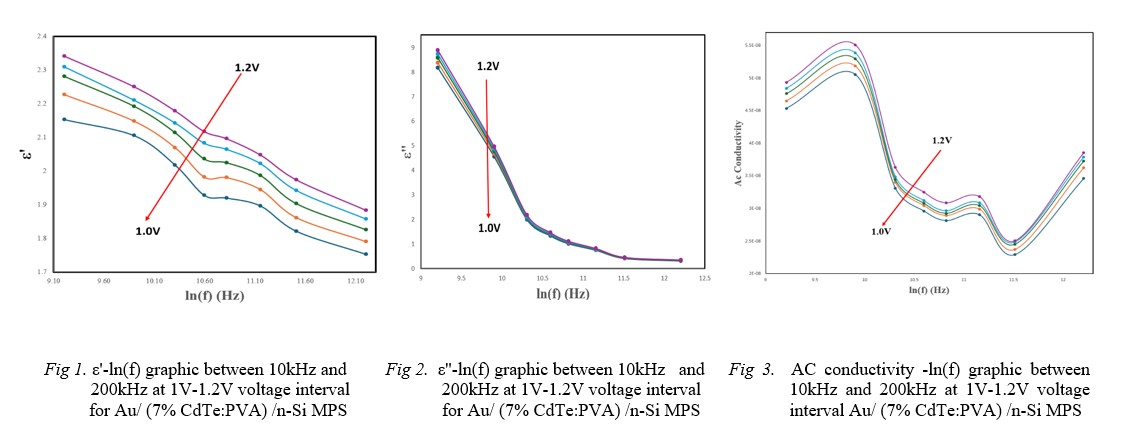
Fig.1-2-3
|
[1] Ö. Berkün, M. Ulusoy, Ş. Altındal, B. Avar. On frequency and voltage dependent physical characteristics and interface states characterization of the metal semiconductor (MS) structures with (Ti:DLC) interlayer, Physica B: Condensed Matter 666, 415099, 2023. https://doi.org/10.1016/j.physb.2023.415099
[2] M. Ulusoy, Y. Badali, G. Pirgholi-Givi, Y. Azizian-Kalandaragh, Ş. Altındal. The capacitance/conductance and surface state intensity characteristics of the Schottky structures with ruthenium dioxide-doped organic polymer interface, Synthetic Metals 292, 117243, 2023. https://doi.org/10.1016/j.synthmet.2022.117243
[3] Y. Şafak Asar, Ö. Sevgili, Ş. Altındal. Investigation of dielectric relaxation and ac conductivity in Au/(carbon nanosheet-PVP composite)/n-Si capacitors using impedance measurements, J. Mater. Sci. Mater. Elect. 34, 893, 2023. https://doi.org/10.1007/s10854-023-10320-1
[4] D. Ata, S. Altındal Yerişkin, A. Tataroğlu, M. Balbaşı. Analysis of admittance measurements of Al/Gr-PVA/p-Si (MPS) structure, Journal of Physics and Chemistry of Solids 169, 110861 2022. https://doi.org/10.1016/j.jpcs.2022.110861
[5] G. Kandhol, H. Wadhwa, S. Chand, S. Mahendia, S. Kumar. Study of dielectric relaxation behavior of composites of Poly (vinylalchohol) (PVA) and Reduced graphene oxide (RGO), Vacuum 160, 384-393, 2019. https://doi.org/10.1016/j.vacuum.2018.11.051
[6] S. Tewari, A. Bhattacharjee, P.P. Sahay. Structural, dielectric, and electrical studies on thermally evaporated CdTe thin films, J. Mater. Sci. 44, 534–540, 2009. https://doi.org/10.1007/s10853-008-3088-x
[7] G. Fussell, J. Thomas, J. Scanlon, A. Lowman, M. Marcolongo. The effect of protein-free versus protein-containing medium on the mechanical properties and uptake of ions of PVA/PVP hydrogels, J. Biomater. Sci. 16, 489–503 (2005) https://doi.org/10.1163/1568562053700219
[8] H. Bouaamlat, N. Hadi, N. Belghiti, H. Sadki, M. N. Bennani, F. Abdi, T. Lamcharfi, M. Bouachrine, M. Abarkan. Dielectric Properties, AC Conductivity, and Electric Modulus Analysis of Bulk Ethylcarbazole-Terphenyl. Hindawi Advances in Materials Science and Engineering, 8689150 1-8 (2020) https://doi.org/10.1155/2020/8689150
[9] A. Feizollahi Vahid, S. Alptekin, N. Basman, M. Ulusoy, Y. Şafak Asar, ޸ Altındal. The investigation of frequency dependent dielectric properties and ac conductivity by impedance spectroscopy in the Al/(Cu-doped Diamond Like Carbon)/Au structures, J. Mater. Sci: Mater. Electron. 34, 1118, 2023. https://doi.org/10.1007/s10854-023-10546-z
[10] Ç.Ş. Güçlü, E. Erbilen Tanrıkulu, M. Ulusoy, Y. Azizian-Kalandaragh, Ş. Altındal. Frequency‑dependent physical parameters, the voltage‑dependent profile of surface traps, and their lifetime of Au/(ZnCdS‑GO:PVP)/n‑Si structures by using the conductance method, J. Mater. Sci: Mater. Electron. 35, 348 (2024) https://doi.org/10.1007/s10854-024-12111-8
[11] A. Abidinov, I. Afandiyeva, E. Bakhtiyarli, S. Altındal Yerişkin, S.A. Hameed.Comprehensive Investigation of Negative Capacitance and Inductive Behavior in Pure and 3% and 5% Ni-Doped PVP-Based Au/n-Si (MS) Schottky Diodes (SDs), ACS Applied Electronic Materials 7 (20) (2025) 9399–9407, https://doi.org/10.1021/acsaelm.5c01377
[12] I.M. Afandiyeva, E.R. Bakhtiyarli, S. Altındal Yerişkin, S.A. Hameed. Negative dielectric and inductive behavior in Au/n-Si diodes with Ni-doped PVP interlayers, Journal of Materials Science: Materials in Electronics 2026, https://doi.org/10.1007/s10854-026-16574-9
[13] A.M. Akbaş, A. Tataroğlu, Ş. Altındal, Y. Azizian-Kalandaragh. Frequency dependence of the dielectric properties of Au/(NG:PVP)/n-Si structures, Journal of Materials Science: Materials in Electronics 32, 7657–7670 (2021) https://doi.org/10.1007/s10854-021-05482-9
[14] G.B. Parravicini, A. Stella, M.C. Ungureanu, R. Kofman. Low-frequency negative capacitance effect in systems of metallic nanoparticles embedded in dielectric matrix, Applied Physics Letters 85 (2) (2004) 302–304, https://doi.org/10.1063/1.1771830
[15] I.Yu. Prosanov, N.F. Uvarov. Electrical properties of dehydrated polyvinyl alcohol, Physics of the Solid State 54 (2) (2012) 421–424, https://doi.org/10.1134/S1063783412020278
[16] Ç.Ş. Güçlü, A. Khalkhali, S.A. Hameed, İ. Taşçıoğlu, A. Demirci, Ş. Altındal. Dielectric response of Au/(Co:PVA)/n-Si/Al structures under varying frequencies and bias voltages, Journal of Materials Science: Materials in Electronics 36 (23) (2025) 1431, https://doi.org/10.1007/s10854-025-15485-5
[17] E.E. Tanrıkulu, S. Demirezen, Ş. Altındal, İ. Uslu. Journal of Materials Science: Materials in Electronics 29 (4) (2018) 2890–2898, https://doi.org/10.1007/s10854-017-8219-1
[18] J.A. Fedotova, A.V. Pashkevich, A.A. Ronassi, T.N. Kołtunowicz, A.K. Fedotov, P. Żukowski, A.S. Fedotov. Negative capacitance of nanocomposites with CoFeZr nanoparticles embedded into silica matrix, Journal of Magnetism and Magnetic Materials 511 (2020) 166963, https://doi.org/10.1016/j.jmmm.2020.166963
[19] G. Fan, Z. Wang, Z. Wei, Y. Liu, R. Fan. Negative dielectric permittivity and high-frequency diamagnetic responses of percolated nickel/rutile cermets, Composites Part A: Applied Science and Manufacturing 139 (2020) 106132, https://doi.org/10.1016/j.compositesa.2020.106132
[20] H. Biederman. Metal doped polymer films prepared by plasma polymerization and their potential applications, Vacuum 34 (1984) 405–410,https://doi.org/10.1016/0042-207X(84)90075-7
[21] G.K. Meenatchi, G. Velraj. Synthesis and characterisation of nickel oxide-carboxylated multiwalled carbon nanotube polymer nanocomposites, Journal of Materials Science: Materials in Electronics 34 (23) (2023) 1686, https://doi.org/10.1007/s10854-023-10234-5
[22] Z. Liang, H.H. Choi, X. Luo, T. Liu, A. Abtahi, U. S. Ramasamy, J. A. Hitron, K. N. Baustert, J. L. Hempel, A. M. Boehm, A. Ansary, D.R. Strachan, J. Mei, C. Risko, V. Podzorov, K.R. Graham. n-type charge transport in heavily p-doped polymers, Nature Materials 20 (4) (2021) 518–524, https://doi.org/10.1038/s41563-020-00859-3
[23] M. Bulinski,. Metal doped PVA films for opto-electronics—optical and electronic properties, an overview, Molecules 26 (10) (2021) 2886, https://doi.org/10.3390/molecules26102886
[24] G. Cárdenas-Triviño, N. Linares-Bermúdez, L. Vergara-González, G. Cabello-Guzmán, J. Ojeda-Oyarzún, M. Nuñez-Decape, R. Arrué-Muñoz. Synthesis and wound healing properties of polyvinyl alcohol films doped with metal nanoparticles of Cu and Ag, Journal of the Chilean Chemical Society 67 (4) (2022) 5667–5674, https://doi.org/10.4067/S0717-97072022000405667
[25] M.H. Al-Dharob, A. Kökce, D.A. Aldemir, A.F. Özdemir, Ş. Altındal. The origin of anomalous peak and negative capacitance on dielectric behavior in the accumulation region in Au/(0.07 Zn-doped polyvinyl alcohol)/n-4H-SiC metal–polymer–semiconductor structures/diodes studied by temperature-dependent impedance measurements, Journal of Physics and Chemistry of Solids 144 (2020) 109523, https://doi.org/10.1016/j.jpcs.2020.109523
[26] Ç. Bilkan, Y. Azizian-Kalandaragh, Ş. Altındal, R. Shokrani-Havigh. Frequency and voltage dependence dielectric properties, ac electrical conductivity and electric modulus profiles in Al/Co₃O₄–PVA/p-Si structures, Physica B: Condensed Matter 500 (2016) 154–160, https://doi.org/10.1016/j.physb.2016.08.001
[27] A.V. Larkin, I.A. Svito, Y.A. Fedotova, A.K. Fedotov. DC and AC conductivity of metal-dielectric film nanocomposites, Bulletin of the Belarusian State University. Ser. 1, Physics. Mathematics. Computer Science, 2009. 1, 26.-37.
[28] N.W. Ashkroft., N.D. Mermin. Solid state Physics. Harcourt College Publishers, 1976.
|