ABSTRACT
A visual interpretation of the electron's wave-particle duality is presented using the example of known manifestations of its diffraction by a macroscopic object
(in particular, a crystal). This interpretation is based on the author's previously established structural features of the electron, which are determined by the balance
between Coulomb repulsion and attractive forces, the latter of which are associated with the electron's intrinsic magnetic moment. The carried analysis allows for a more
profound and visual understanding of the electron's transformation under certain conditions from a classical "point" state to a bulk quantum "electron cloud" and vice versa.
It is noted that the results of this work could not have been obtained on the basis of quantum electrodynamics, which treats the electron as a structureless point particle.
Keywords: point-like free electron, quantum “electron cloud”, wave-particle duality, diffraction.
DOI:10.70784/azip.1.2026142
Received: 19.02.2026
Internet publishing: 24.02.2026 AJP Fizika E 2026 1 en p.42-44
AUTHORS & AFFILIATIONS
Institute of Physics, Azerbaijan Republic Ministry of Sciences and Education, Baku, AZ-1073, Azerbaijan
E-mail: izmailov57@yahoo.com
Graphics and Images
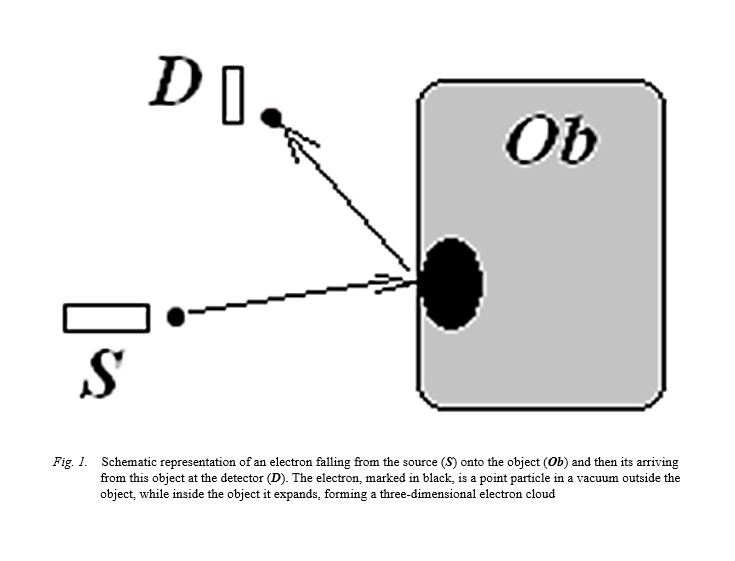
Fig.1
|
[1] H.A. Lorentz. 2022. The Theory of Electrons and Its Applications to the Phenomena of Light and Radiant Heat: A Course of Lectures Delivered in Columbia University, New York, in March and April, 1906. Creative Media Partners, LLC.
[2] C.S. Helrich. 2021. The Quantum Theory—Origins and Ideas: A Historical Primer for Physics Students. Springer Nature Switzerland.
[3] Max Born. 1969. Atomic Physics. (8-th edition), Dover Publications Inc., New York.
[4] H. Dehmelt. 1988. A single atomic particle forever floating at rest in free space: New value for electron radius. Physica Scripta, V 22, 102-110.
[5] A.Ch. Izmailov. 2025. On the fusion of like-charged particles in vacuum due to the attraction of their intrinsic magnetic moments. AJP FIZIKA, section: E, V. 31, N 4, 17-20. http://www.physics.gov.az/physart/471_2025_04_17_en.pdf
[6] A.I. Miller. 1995. Early quantum electrodynamics: A sourcebook. Cambridge University Press.
[7] M.A. VanHove, W.H. Weinberg, Chi-Ming Chan. 1986. Low-Energy Electron Diffraction: Experiment, Theory and Surface Structure determination. Springer-Verlag.
[8] L.-M. Peng, S.L. Dudarev, M.J. Whelan. 2004. High Energy Electron Diffraction and Microscopy. Oxford University Press.
[9] R.F. Egerton. 2005. Physical Principles of Electron Microscopy. Springer.
[10] M.K. Sundaresan. 2017. Handbook of particle physics. CRC Press.
|