ABSTRACT
GaSe nanoparticles were synthesized using the pulsed laser ablation in liquid (LAL) technique and deposited onto n-type silicon substrates to form GaSe nanoparticle/Si
heterostructures. The LAL method enabled the production of high-purity nanoparticles without the use of chemical precursors or surfactants. The structural, morphological,
compositional, and vibrational properties of the obtained heterostructures were systematically investigated using X-ray diffraction (XRD), scanning electron microscopy
(SEM), energy-dispersive X-ray spectroscopy (EDS), and Raman spectroscopy. XRD analysis revealed the presence of crystalline hexagonal GaSe nanoparticles along with the
dominant diffraction peak of the Si substrate. SEM observations showed the formation of nanoparticles with sizes ranging from tens to several hundreds of nanometers
distributed across the silicon surface. EDS measurements confirmed the presence of Ga and Se elements, verifying the successful deposition of GaSe nanoparticles.
Raman spectroscopy identified characteristic phonon modes of GaSe, including A1g and E2g vibrations, confirming the preservation of the layered crystal structure after
laser ablation. The results demonstrate that the pulsed laser ablation in liquid method is an effective approach for the synthesis of GaSe nanoparticles and the fabrication
of GaSe nanoparticle/Si heterostructures. The obtained structures show promising potential for future optoelectronic and photodetector applications.
Keywords: Nanoparticles, pulsed laser ablation, X-ray diffraction, scanning electron microscopy, energy-dispersive X-ray spectroscopy, Raman spectroscopy, phonon modes, quantum confinement, surface effects.
DOI:10.70784/azip.1.2026145
Received: 24.02.2026
Internet publishing: 11.03.2026 AJP Fizika E 2026 1 en p.45-50
AUTHORS & AFFILIATIONS
a. Department of Semiconductor physics, Baku State University, 23 Academic Zahid Khalilov Street, Baku AZ1148, Azerbaijan.
b. Institute of Physics, Ministry of Science and Education, Baku AZ1073, Azerbaijan
*E-mail: vagif_salmanov@yahoo.com
Graphics and Images
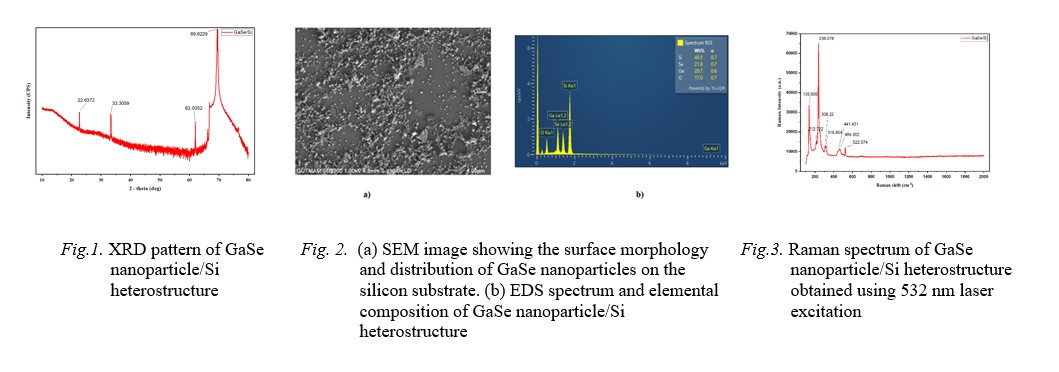
Fig.1-2-3
|
[1] H. Wang, H. Wu, W. Lin, B. Zhang, X. Li, Y. Zhang, S. Fan, C. Dang, Y. Zhu, S. Zhao, X. Zhou. Orientation-dependent large plasticity of single-crystalline gallium selenide. Cell Reports Physical Science. 2022 Apr 20;3(4).
[2] T.H. Fang, D.Q. Doan. Effects of surface defects on mechanical properties and fracture mechanism of gallium selenide/graphene heterostructure. Mechanics of Materials. 2023 May 1;180:104610.
[3] ZHAO, Qinghua. Two-dimensional III via semiconductors and their applications in optoelectronic devices. 2020.
[4] S. Mou, A. Rubano, D. Paparo. Terahertz hyper-Raman time-domain spectroscopy of gallium selenide and its application in terahertz detection. Applied Physics Letters. 2019 Nov 18;115 (21).
[5] M. Song, N. An, Y. Zou, Y. Zhang, W. Huang, H. Hou, X. Chen. Epitaxial growth of 2D gallium selenide flakes for strong nonlinear optical response and visible-light photodetection. Frontiers of Physics. 2023 Oct;18(5):52302.
[6] K.O. Jongkuk, et al. Electronic effects of nano-confinement in functional organic and inorganic materials for optoelectronics. Chemical Society Reviews, 2021, 50.5: 3585-3628.
[7] PALMSTROM, Axel F.; SANTRA, Pralay K.; BENT, Stacey F. Atomic layer deposition in nanostructured photovoltaics: tuning optical, electronic and surface properties. Nanoscale, 2015, 7.29: 12266-12283.
[8] RAMANATHAN, Santheraleka, et al. Nanoparticle synthetic methods: strength and limitations. In: Nanoparticles in Analytical and Medical Devices. Elsevier, 2021. p. 31-43.
[9] HACHEM, Kadda, et al. Methods of chemical synthesis in the synthesis of nanomaterial and nanoparticles by the chemical deposition method: a review. BioNanoScience, 2022, 12.3: 1032-1057.
[10] KHAIRANI, Y. Inna, et al. Green nanoparticle synthesis at scale: a perspective on overcoming the limits of pulsed laser ablation in liquids for high-throughput production. Physical Chemistry Chemical Physics, 2023, 25.29: 19380-19408.
[11] MONSA, Yaakov, et al. A simple strategy for enhanced production of nanoparticles by laser ablation in liquids. Nanotechnology, 2020, 31.23: 235601.
[12] FAZIO, Enza, et al. Nanoparticles engineering by pulsed laser ablation in liquids: Concepts and applications. Nanomaterials, 2020, 10.11: 2317.
[13] SORIFI, Sahin; KAUSHIK, Shuchi; SINGH, Rajendra. A GaSe/Si-based vertical 2D/3D heterojunction for high-performance self-driven photodetectors. Nanoscale Advances, 2022, 4.2: 479-490.
[14] CHI, Tran Thi Kim, et al. Preparation of SERS substrates for the detection of organic molecules at low concentration. Commun. Phys, 2016, 26: 261-268.
[15] V.M. Salmanov, A.G. Guseinov, M.A. Dzhafarov, et al. Preparation of Gallium Selenide Nanoparticles by Laser Ablation in Liquid. Russ. J. Phys. Chem. 98, 479–483 (2024).
[16] BALAYEVA, Lamiya, et al. Effect of Low-Concentration Boron Incorporation on the Structural Coherence and Phonon Modes of Layered GaSe. Micro and Nanostructures, 2026, 208604.
[17] V.V. KIDALOV, et al. Properties of SiC films obtained by the method of substitution of atoms on porous silicon. ECS Journal of Solid State Science and Technology, 2018, 7.4: P158.
|